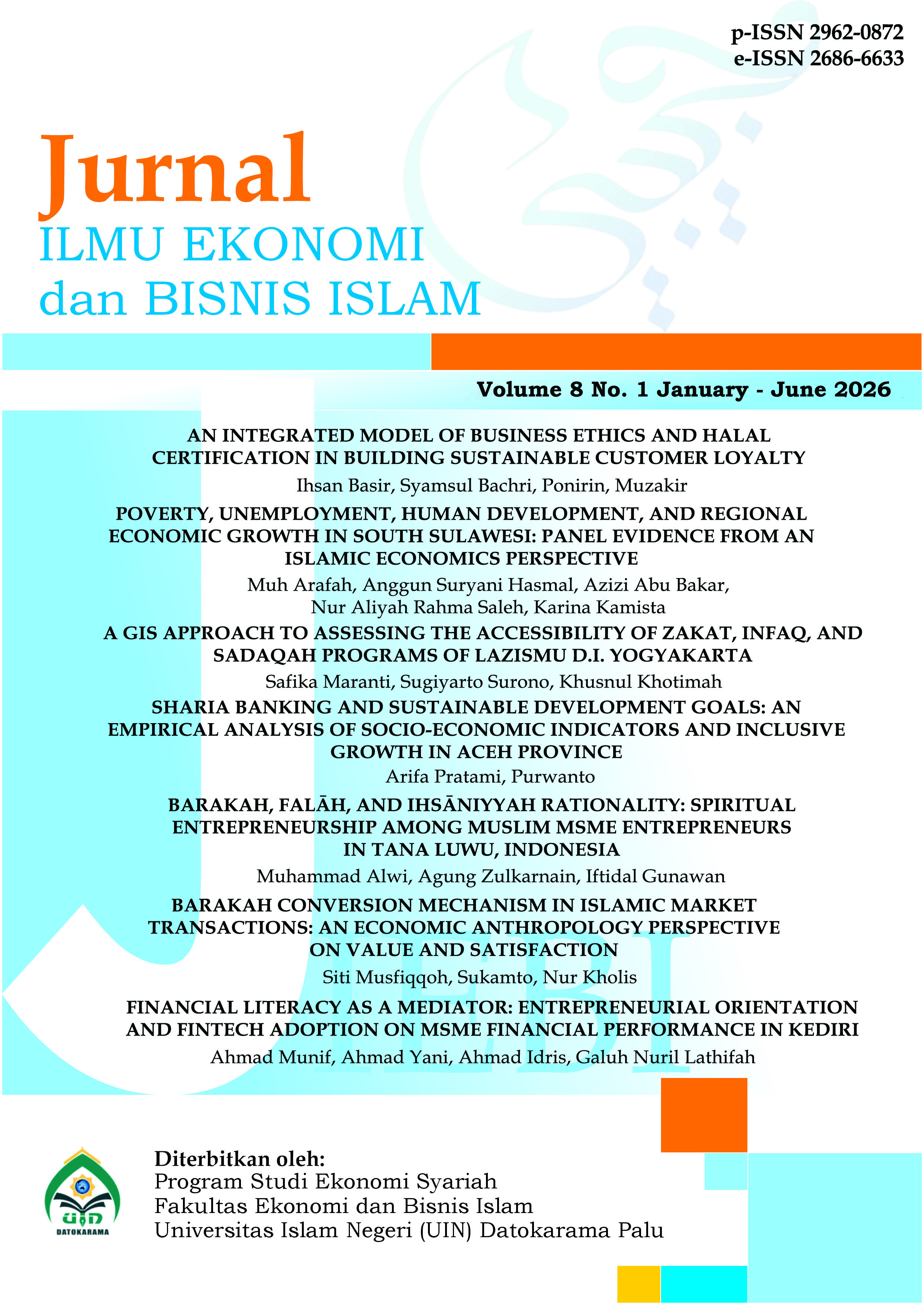
Poverty, Unemployment, Human Development, and Regional Economic Growth in South Sulawesi: Panel Evidence from an Islamic Economics Perspective
DOI:
https://doi.org/10.24239/jiebi.v8i1.434.14-31Keywords:
regional economic growth, poverty, open unemployment rate, human development index, Islamic economicsAbstract
Regional economic growth does not always lead to poverty reduction, labor absorption, or equitable welfare improvement. This study examines the relationship between poverty, the open unemployment rate, the Human Development Index (HDI), and regional economic growth across twenty-four regencies/municipalities in South Sulawesi during 2021–2025. Using balanced panel data, the study applies panel regression analysis, with the Common Effect Model selected through model specification tests. Because diagnostic tests indicate heteroskedasticity and first-order autocorrelation, the final estimation employs White period standard errors with cross-section clustering. The results show that poverty has a negative but statistically insignificant relationship with regional economic growth, while the open unemployment rate and HDI are also statistically insignificant. These findings suggest that short-term regional growth in South Sulawesi is not sufficiently explained by poverty, unemployment, and human development indicators alone, but may beinfluenced by broader structural factors, including sectoral composition, investment, public expenditure, infrastructure, and local recovery capacity. From an Islamic economics perspective, this study highlights the need to orient regional development beyond output expansion toward distributive justice, poverty reduction, productive employment, and welfare-based growth.
References
Agussalim, A., Nursini, N., Suhab, S., Kurniawan, R., Samir, S., & Tawakkal, T. (2024). The Path to Poverty Reduction: How Do Economic Growth and Fiscal Policy Influence Poverty Through Inequality in Indonesia? Economies, 12(12), 316. https://doi.org/10.3390/economies12120316
Ali, I., & Son, H. H. (2007). Measuring Inclusive Growth. Asian Development Review, 24(01), 11–31. https://doi.org/10.1142/S0116110507000024
Ali, M., Agustina, L. K., & Pahrudin, P. (2024). How Do Economic Development Indicators Affect the Poverty Level? Evidence from West Nusa Tenggara. Jurnal Economia, 20(2), 183–196. https://doi.org/10.21831/economia.v20i2.67760
Alwi, A. A., Syaparuddin, S., & Hardiani, H. (2021). Pengaruh pertumbuhan ekonomi dan tingkat pendidikan terhadap kemiskinan dengan pengangguran sebagai variabel intervening di Provinsi Jambi 2004-2018. E-Jurnal Perspektif Ekonomi Dan Pembangunan Daerah, 10(2), 83–92. https://doi.org/10.22437/pdpd.v10i2.12732
Arwani, A., & Wahdati, A. (2020). Effect of Zakat, Infak and Sedekah (ZIS), Index Human Development (HDI) and Unemployment on Indonesian Economic Growth At 2013-2017. Al-Tijary, 159–173. https://doi.org/10.21093/at.v5i2.2220
Ascarya, A. (2022). The role of Islamic social finance during Covid-19 pandemic in Indonesia’s economic recovery. International Journal of Islamic and Middle Eastern Finance and Management, 15(2), 386–405. https://doi.org/10.1108/IMEFM-07-2020-0351
Aydin, N. (2017). Islamic vs conventional Human Development Index: empirical evidence from ten Muslim countries. International Journal of Social Economics, 44(12), 1562–1583. https://doi.org/10.1108/IJSE-03-2016-0091
Ayuniyyah, Q., Pramanik, A. H., Md Saad, N., & Ariffin, M. I. (2022). The impact of zakat in poverty alleviation and income inequality reduction from the perspective of gender in West Java, Indonesia. International Journal of Islamic and Middle Eastern Finance and Management, 15(5), 924–942. https://doi.org/10.1108/IMEFM-08-2020-0403
Az zakiyyah, N. A., Khoirudin, R., & Gatari, A. P. (2025). The effect of economic growth on income inequality in the Special Region of Yogyakarta. Jurnal Ekonomi & Studi Pembangunan, 26(1), 33–46. https://doi.org/10.18196/jesp.v26i1.25361
Baltagi, B. H. (2021). Econometric Analysis of Panel Data. Springer International Publishing. https://doi.org/10.1007/978-3-030-53953-5
Becker, G. S. . (2009). Human Capital : a Theoretical and Empirical Analysis, with Special Reference to Education. University of Chicago Press.
BPS Provinsi Sulawesi Selatan. (2025). Economic growth, poverty, open unemployment rate, and Human Development Index by regency/municipality in South Sulawesi, 2021–2025.
Breusch, T. S., & Pagan, A. R. (1980). The Lagrange Multiplier Test and its Applications to Model Specification in Econometrics. The Review of Economic Studies, 47(1), 239. https://doi.org/10.2307/2297111
Dartanto, T., Susanti, H., Augustin, E., & Fitriani, K. (2023). Reemployment during the Covid-19 pandemic in Indonesia: What kinds of skill sets are needed? Cogent Economics & Finance, 11(2). https://doi.org/10.1080/23322039.2023.2210382
Daud, N., Possumah, B. T., Nugraha, R. A., Sukri Mustofa, S., & Amin, C. (2024). Investigating the impact of the COVID-19 pandemic and macroeconomic variables on unemployment among university graduates in Indonesia: Regression and Fs-QCA approaches. Cogent Economics & Finance, 12(1). https://doi.org/10.1080/23322039.2024.2382350
De Silva, I., & Sumarto, S. (2015). Dynamics of Growth, Poverty And Human Capital: Evidence from Indonesian Sub-National Data. Journal of Economic Development, 40, 1–33. https://doi.org/10.35866/caujed.2015.40.2.001
Didu, S., Chendrawan, T. S., & Ul Jannah, A. N. S. (2023). Analysis of Factors Affecting Poverty in Eastern Indonesia. Tirtayasa Ekonomika, 18(2), 159. https://doi.org/10.35448/jte.v18i2.23203
Ernawati, E., Tajuddin, T., & Nur, S. (2021). Does Government Expenditure Affect Regional Inclusive Growth? An Experience of Implementing Village Fund Policy in Indonesia. Economies, 9(4), 164. https://doi.org/10.3390/economies9040164
Fitriady, A., Silvia, V., & Suriani, S. (2022). The Impact of Macroeconomic Variables on the Real Economic Growth in Indonesia. International Journal of Global Optimization and Its Application, 1(2), 70–79. https://doi.org/10.56225/ijgoia.v1i2.16
Gujarati, D. N. ., & Porter, D. C. . (2010). Basic econometrics. McGraw-Hill.
Harnani, S. (2023). Contribution of Economic Growth, Demography, Human Capital Quality, and Unemployment to Poverty Dynamics. Atestasi : Jurnal Ilmiah Akuntansi, 6(1), 565–582. https://doi.org/10.57178/atestasi.v6i1.1000
Harsono, P., Istiqomah, & Gunawan, D. S. (2025). The Impact of Regional Competitiveness on GRDP: Mediating Roles of Unemployment and Poverty in Indonesia. International Journal of Accounting and Economics Studies, 12(4), 21–28. https://doi.org/10.14419/bq5qsk45
Hausman, J. A. (1978). Specification Tests in Econometrics. Econometrica, 46(6), 1251. https://doi.org/10.2307/1913827
Hidayat, I., Mulatsih, S., & Rindayati, W. (2020). The Determinants of Inclusive Economic Growth in Yogyakarta. Jurnal Economia, 16(2), 200–210. https://doi.org/10.21831/economia.v16i2.29342
Ilham, A. P., Muljaningsih, S., & Sasongko, S. (2023). The Effect of Natural Disaster on Regional Economic Growth, Unemployment, Poverty, and Human Development Index in Thirty Indonesian Provinces. Journal of Indonesian Applied Economics, 11(1), 40–59. https://doi.org/10.21776/ub.jiae.2023.011.01.4
Khan, A., Khan, G., Safdar, S., Munir, S., & Andleeb, Z. (2016). Measurement and Determinants of Inclusive Growth: A Case Study of Pakistan (1990-2012). The Pakistan Development Review, 455–466. https://doi.org/10.30541/v55i4I-IIpp.455-466
Komariyah, S., Priyono, T. H., & Nathania, C. A. (2023). Impact of Poverty, Economic Growth, and Information and Communication Technology on Human Development. Journal of Economics, Business, & Accountancy Ventura, 26(1), 129–138. https://doi.org/10.14414/jebav.v26i1.2939
Leasiwal, T. C., Oppier, H., Tutupoho, A., & Palloma, A. (2022). Examining The Effects of Economic Growth on Unemployment in Indonesia. Journal of Social Science, 3(5), 972–985. https://doi.org/10.46799/jss.v3i5.389
Machmud, S., & Sidharta, I. (2023). The relationship between regional development, human development and poverty: A perspective from the Indonesian province. Nurture, 17(3), 157–165. https://doi.org/10.55951/nurture.v17i3.283
Malik, N., Suliswanto, M. S. W., & Rofik, M. (2021). The Unemployment Rate Amid the COVID-19 Pandemic: Propose the Best Practices Policy to Maintain Labor Market Stability. Jurnal Ilmu Sosial Dan Ilmu Politik, 25(1), 48. https://doi.org/10.22146/jsp.56450
Marrero, G. A., & Servén, L. (2022). Growth, inequality and poverty: a robust relationship? Empirical Economics, 63(2), 725–791. https://doi.org/10.1007/s00181-021-02152-x
Maryam, A. K., Yusuf, A. A., & Sudrajat, A. (2024). Economic Growth Vs. Poverty in Indonesia: What has Happened? Journal of Economics, Finance And Management Studies, 07(04). https://doi.org/10.47191/jefms/v7-i4-15
Masduki, U., Rindayati, W., & Mulatsih, S. (2022). How can quality regional spending reduce poverty and improve human development index? Journal of Asian Economics, 82, 101515. https://doi.org/10.1016/j.asieco.2022.101515
Mubarak, M. S., & SBM, N. (2020). The Impact of Population, Labor, Unemployment, and Poverty on Economic Growth Regencies/Municipality in Sulawesi Tengah Province. Jurnal Ekonomi Pembangunan, 18(1), 62. https://doi.org/10.22219/jep.v18i1.11736
Mushtaq, H., & Zaman, K. (2021). In Search of Pakistan’s Inclusive Growth: Evidence from Income and Non-Income Dimensions. Social Change, 51(2), 226–240. https://doi.org/10.1177/00490857211013592
Mutmainah, S., Rahayu, N. W. I., Fauzan, F., & Sholichin, A. A. (2024). The influence of zakat, Human Development Index, open unemployment rate, and income on poverty in Indonesia. Journal of Islamic Economics Lariba, 10(1), 363–382. https://doi.org/10.20885/jielariba.vol10.iss1.art20
Naufal, A., & Fikriah, F. (2023). Regional Nexus of Economic Growth, Income Inequality and Poverty. Ekonomikalia Journal of Economics, 1(2), 61–68. https://doi.org/10.60084/eje.v1i2.114
Ningrum, J. W., Khairunnisa, A. H., & Huda, N. (2020). Pengaruh Kemiskinan, Tingkat Pengangguran, Pertumbuhan Ekonomi dan Pengeluaran Pemerintah Terhadap Indeks Pembangunan Manusia (IPM) di Indonesia Tahun 2014-2018 dalam Perspektif Islam. Jurnal Ilmiah Ekonomi Islam, 6(2), 212. https://doi.org/10.29040/jiei.v6i2.1034
Novreska, S., & Arundina, T. (2024). The Role of Islamic Financial Inclusion in Poverty, Income Inequality, and Human Development in Indonesia. Journal of Islamic Monetary Economics and Finance, 10(1), 135–154. https://doi.org/10.21098/jimf.v10i1.1973
Nurias, N., Johari, S. M., Muljarijadi, B., & Wardhana, A. (2023). Reducing the provincial poverty rate in Indonesia: The impact of local government expenditure. Jurnal Ekonomi & Studi Pembangunan, 24(2), 297–315. https://doi.org/10.18196/jesp.v24i2.18618
Nurlina, Safuridar, & Maula, Z. (2021). Analysis of Inclusive Economic Development Index and Poverty in Aceh Province, Indonesia. https://doi.org/10.2991/aebmr.k.210616.020
Nurrahman, A. (2024). Handling Unemployment in Indonesia. Jurnal Registratie, 6(1), 1–17. https://doi.org/10.33701/jurnalregistratie.v6i1.4054
Ozdemir, M., Savasan, F., & Ulev, S. (2023). Leveraging financial inclusion through Islamic microfinance: A new model proposal for participation banks in Turkiye. Borsa Istanbul Review, 23(3), 709–722. https://doi.org/10.1016/j.bir.2023.01.011
Pratomo, D., Oktanira, C., Kurniawan, M., & Ar-Royyan Ramly. (2024). Poverty, Unemployment, and HDI Impact on ASEAN Economic Growth: An Islamic Approach. JEKSYAH: Islamic Economics Journal, 4(02), 89–98. https://doi.org/10.54045/jeksyah.v4i02.1774
Purwanti, D. (2024). Inclusive economic growth and fiscal intervention: could it reduce poverty, inequality, and unemployment in East Java? Jurnal Ekonomi & Studi Pembangunan, 25(1), 148–166. https://doi.org/10.18196/jesp.v25i1.21694
Rajlakshmi Datta, H. B. M. S. M. P. D. S. (2025). Relationship Between Select Labour Market Variables and Economic Growth: An Investigation for Some South and Southeast Asian Nations. Economic Sciences, 21(02(S) August), 216–227. https://doi.org/10.69889/51sdx159
Ratnasari, V., Audha, S. H., & Dani, A. T. R. (2023). Statistical modeling to analyze factors affecting the middle-income trap in Indonesia using panel data regression. MethodsX, 11, 102379. https://doi.org/10.1016/j.mex.2023.102379
Razak, A. A., & Asutay, M. (2022). Financial inclusion and economic well-being: Evidence from Islamic Pawnbroking (Ar-Rahn) in Malaysia. Research in International Business and Finance, 59, 101557. https://doi.org/10.1016/j.ribaf.2021.101557
Rizky, M. D., Lubis, S. N., & Kesuma, S. I. (2024). Economic Growth, Poverty, Unemployment, and the Human Development Index (HDI) in Mitigating Socio-economic Disparities in North Sumatra (2019-2023): An Econometric Case Study. South Asian Journal of Social Studies and Economics, 21(12), 302–311. https://doi.org/10.9734/sajsse/2024/v21i12938
Rusanti, E., Anindya, A. S., Atiya, N., & Widiastuti, T. (2023). Does Zakat Impact on Human Development Index? Empirical Evidence from Indonesia. International Journal of Zakat, 8(2), 36–47. https://doi.org/10.37706/ijaz.v8i2.475
Sari, I., Noviarita, H., & Devi, Y. (2024). Islamic Economic Perspective on Poverty Level: Determination of Economic Growth, Unemployment Levels, and Minimum Wages in Lampung Province. Advances in Business Research International Journal, 9(2), 48–63. https://doi.org/10.24191/abrij.v9i2.5155
Schultz, T. W. (1961). Investment in Human Capital. The American Economic Review, 51(1), 1–17. http://www.jstor.org/stable/1818907
Setyowati, W. R., Budi Santoso, D., & Ekawaty, M. (2021). Analysis of the Role of Regional Governments on Inclusive Growth (Macroeconomic Approach Study). International Journal of Social and Local Economic Governance, 7(1), 1–7. https://doi.org/10.21776/ub.ijleg.2021.007.01.1
Ssenyonga, M. (2021). Imperatives for post COVID-19 recovery of Indonesia’s education, labor, and SME sectors. Cogent Economics & Finance, 9(1). https://doi.org/10.1080/23322039.2021.1911439
Suci, L. E., Addainuri, M. I., & Abidin, M. (2023). The Effect of Economic Growth, Education, Unemployment, and Human Development Index on Poverty in the Special Region of Yogyakarta for Period 2015-2021. Jurnal Ilmu Ekonomi Terapan, 8(2), 284–296. https://doi.org/10.20473/jiet.v8i2.51028
Sulaeman, M., Suharno, S., & Ahmad, A. A. (2024). Economic Growth in Indonesia: Dynamics of Poverty, Unemployment, and Health Budgets. Agregat: Jurnal Ekonomi Dan Bisnis, 8(2), 179–198. https://doi.org/10.22236/agregat_vol8.i2/16418
Utami, H. W., & Masjkuri, S. U. (2020). Pengaruh Pertumbuhan Ekonomi, Upah Minimum, Tingkat Pengangguran Terbuka Dan Pendidikan Terhadap Jumlah Penduduk Miskin. Jurnal Ekonomi Dan Bisnis Airlangga, 28(2), 105. https://doi.org/10.20473/jeba.V28I22018.105-116
Verawaty, V., Gunarto, M., Wahasusmiah, R., & Merina, C. I. (2021, March 7). Determinants of Human Development Index in Indonesia. Proceedings of the International Conference on Industrial Engineering and Operations Management. https://doi.org/10.46254/AN11.20210750
Viollani, K. A., Siswanto, S., & Suprayitno, E. (2022). Pengaruh islamic human development index dan pertumbuhan ekonomi terhadap kemiskinan dengan pengangguran sebagai variabel intervening. Fair Value: Jurnal Ilmiah Akuntansi Dan Keuangan, 4(11), 5233–5244. https://doi.org/10.32670/fairvalue.v4i11.1855
White, H. (1980). A Heteroskedasticity-Consistent Covariance Matrix Estimator and a Direct Test for Heteroskedasticity. Econometrica, 48(4), 817. https://doi.org/10.2307/1912934
Wooldridge, J. M. . (2020). Introductory econometrics: a modern approach. Cengage.
Yusnuri, R. A., & Abubakar, J. (2023). Analysis of Human Development Index, Unemployment and Poverty on Economic Growth in Indonesia. International Journal of Social Science, Educational, Economics, Agriculture Research and Technology (IJSET), 2(8), 346–358. https://doi.org/10.54443/ijset.v2i8.190
Zizzamia, R. (2020). Is employment a panacea for poverty? A mixed-methods investigation of employment decisions in South Africa. World Development, 130, 104938. https://doi.org/10.1016/j.worlddev.2020.104938
Downloads
Published
Issue
Section
License
All submitted article manuscripts must go through all review stages for the journal Jurnal Ilmu Ekonomi dan Bisnis Islam to accept and publish them. By submitting the manuscript, authors agree to the following terms:
- The authors guarantee that the article is original and has not been previously published. The article does not contain illegal statements and does not infringe upon the rights of others. The authors affirm that the article is entirely their own copyright. If there are quotations or references from other sources, authors must obtain written permission and ensure that the quotations are free from third-party rights.
- Authors retain the copyright to their work and grant the first publication rights to the Jurnal Ilmu Ekonomi dan Bisnis Islam under the Creative Commons Attribution-NonCommercial License 4.0 International (CC BY-NC 4.0). This license allows others to share the work while attributing the authorship and initial publication to this journal. However, commercial use of the work is not permitted.
- Authors are permitted to make additional contractual arrangements for non-exclusive distribution of the published journal version. For example, they may submit the article to an institutional repository or publish it in a book, with acknowledgement of the initial publication in this journal.
- Authors are allowed and encouraged to post their work online before and during the submission process. This is considered to promote productive exchange and early and broader citation of published work (see the Influence of Open Access).
 All articles in the Jurnal Ilmu Ekonomi dan Bisnis Islam are licensed under the Creative Commons Attribution-NonCommercial 4.0 International License.


2.png)