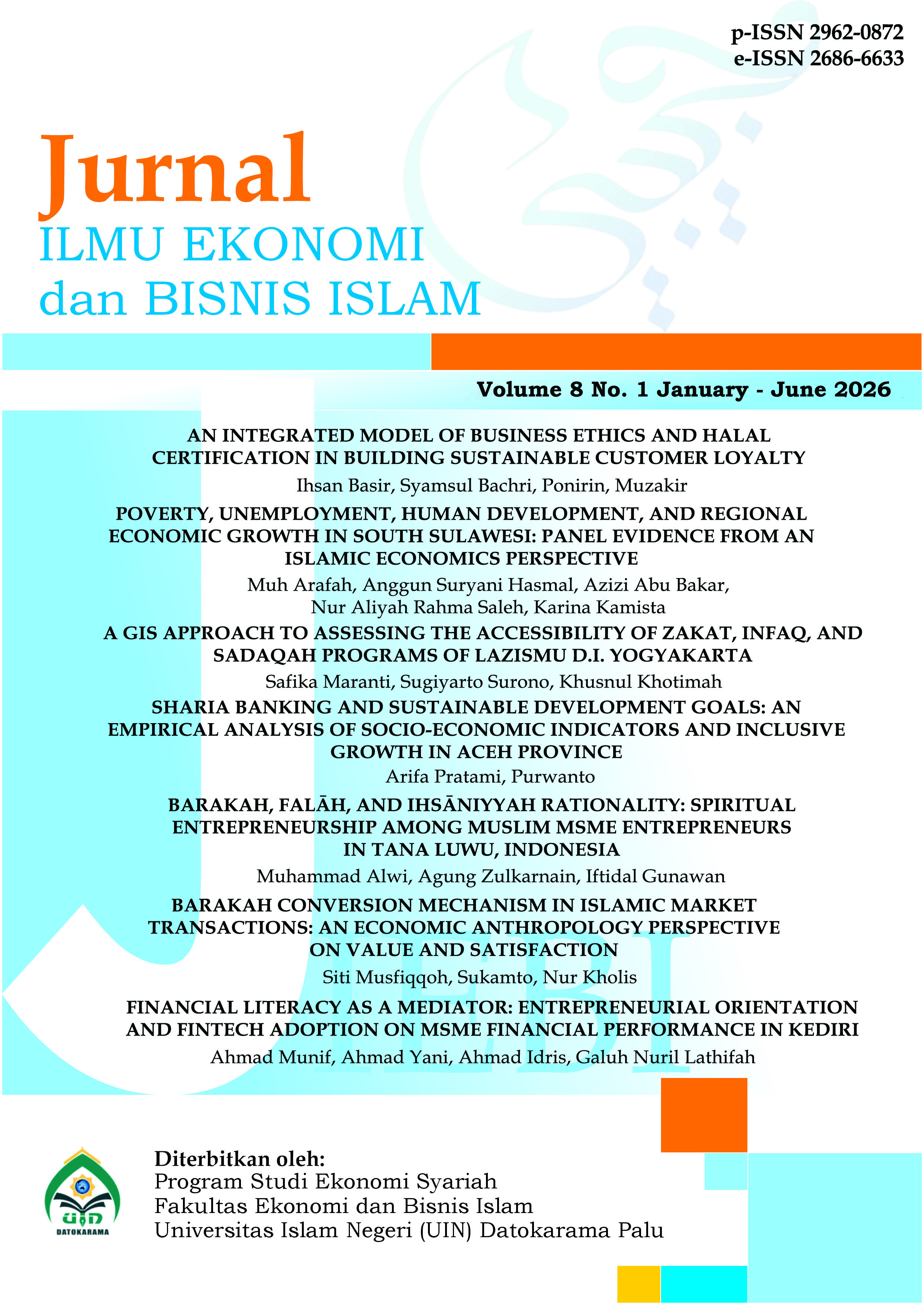
Barakah Conversion Mechanism in Islamic Market Transactions: An Economic Anthropology Perspective on Value and Satisfaction
DOI:
https://doi.org/10.24239/jiebi.v8i1.465.82-96Keywords:
Barakah, Customer satisfaction, Economic anthropology, Halal marketing, Perceived valueAbstract
Islamic market transactions integrate economic, ethical, and spiritual dimensions that are not fully captured by conventional models of value and satisfaction. This study examines how barakah (divine blessing) shapes value and satisfaction in Islamic market transactions from an economic anthropology perspective. Existing studies on halal marketing and Islamic consumer behavior have largely treated religiosity and ethical attributes as predictors of trust or loyalty, while the lived mechanism through which spiritual values become embedded in market exchange remains underexplored. Using ethnography, data were collected through participant observation and in-depth interviews with Muslim traders and consumers in the Ampel religious tourism district of Surabaya, Indonesia. The findings show that barakah operates as a moral-economic mechanism linking spiritual commitment to trust, satisfaction, business continuity, and redistributive consumption. Traders enact barakah through honesty, transparency, and halal integrity, while consumers interpret these practices as signs of religious accountability, strengthening satisfaction and repeat patronage. The study also finds that taṣarruf (purposeful spending) connects functional consumption with spiritual intention and informal redistribution. This study contributes to Islamic economics by positioning barakah as a lived market mechanism that strengthens ethical authenticity, consumer trust, and long-term resilience in Islamic business practice.
References
Abd Rahman, A., Singhry, H. B., Hanafiah, M. H., & Abdul, M. (2017). Influence of perceived benefits and traceability system on the readiness for Halal Assurance System implementa-tion among food manufacturers. Food Control, 73, 1318–1326. https://doi.org/10.1016/j.foodcont.2016.10.058
Abror, A., Patrisia, D., Engriani, Y., Evanita, S., Yasri, Y., & Dastgir, S. (2019). Ser-vice quality, religiosity, customer satis-faction, customer engagement and Is-lamic bank’s customer loyalty. Journal of Islamic Marketing, 11(6), 1691–1705. https://doi.org/10.1108/JIMA-03-2019-0044
Ali, M. H., Tan, K. H., & Ismail, M. D. (2017). A supply chain integrity framework for halal food. British Food Journal, 119(1), 20–38. https://doi.org/10.1108/BFJ-07-2016-0345
Alserhan, B. A. (2020). Principles of Islamic Marketing (1st ed.). Taylor & Francis Group. https://doi.org/10.4324/9781003075110
Ariyono, K. Y., Irdiana, S., Darmawan, K., & Khairullah, M. N. (2023). The Role of Tourists in Increasing Community In-come in the Sunan Ampel Tourism Re-ligious Tourism Area in Surabaya. Jurnal Cakrawala Ilmiah, 2(5), 1901–1910. https://doi.org/10.53625/jcijurnalcakrawalailmiah.v2i5.4613
Asutay, M. (2012). Conceptualising and Locat-ing the Social Failure of Islamic Fi-nance: Aspirations of Islamic Moral Economy vs. the Realities of Islamic Fi-nance. Asian and African Area Studies, 11(2), 93–113. https://doi.org/10.14956/asafas.11.93
Battour, M., & Ismail, M. N. (2016). Halal tour-ism: Concepts, practises, challenges and future. Tourism Management Per-spectives, 19, 150–154. https://doi.org/10.1016/j.tmp.2015.12.008
Bourdieu, P. (1986). The forms of capital. In J. G. Richardson (Ed.), Handbook of theory and research for the sociology of education (pp. 241–258). Greenwood.
Braun, V., & Clarke, V. (2019). Reflecting on reflexive thematic analysis. Qualitative Research in Sport, Exercise and Health, 11(4), 589–597. https://doi.org/10.1080/2159676X.2019.1628806
Carrier, J. G. (2018). Moral economy: Rethinking a radical concept. Routledge.
Changalima, I. A. (2025). Halal supply chain management: A bibliometric analysis of the 100 most-cited publications from Scopus-indexed journals. Social Sciences & Humanities Open, 11, 101248. https://doi.org/10.1016/j.ssaho.2024.101248
Chapra, M. U. (2000). The future of economics: An Islamic perspective. Islamic Founda-tion.
Creswell, J. W., & Poth, C. N. (2023). Qualita-tive Inquiry and Research Design: Choos-ing Among Five Approaches (5th ed.). SAGE Publications.
Denzin, N. K., Lincoln, Y. S., Giardina, M. D., & Cannella, G. S. (Eds.). (2024). The SAGE Handbook of Qualitative Research (Sixth edition). SAGE.
Dusuki, A. W., & Abdullah, N. I. (2007). Maqasid al-Shari`ah, Maslahah, and Corporate Social Responsibility. Ameri-can Journal of Islam and Society, 24(1), 25–45. https://doi.org/10.35632/ajis.v24i1.415
Geertz, C. (1963). Peddlers and princes: Social change and economic modernization in two Indonesian towns. University of Chicago Press.
Guest, G., Namey, E., & Chen, M. (2020). A simple method to assess and report thematic saturation in qualitative re-search. PLOS ONE, 15(5), e0232076. https://doi.org/10.1371/journal.pone.0232076
Gupta, G., Paruthi, M., & Nijjer, S. (2023). Re-ligion and Consumer Behaviour (1st ed.). Taylor & Francis Group. https://doi.org/10.4324/9781003288558
Harsanto, B., Pradana, M., Yunani, A., Fir-mansyah, E. A., Apriliadi, A., Farras, J. I., & Nabila, F. S. (2024). Halal value chain: A structured literature review and meta-analysis. Journal of Islamic Marketing, 16(4), 1095–1117. https://doi.org/10.1108/JIMA-12-2023-0387
Iqbal, Z., & Mirakhor, A. (2017). Ethical dimen-sions of Islamic finance: Theory and prac-tice (1st ed. 2017). Palgrave Macmillan. https://doi.org/10.1007/978-3-319-66390-6
Ismail, I. J. (2025). Halal brand quality and hal-al food purchasing intention among university students: The moderating ef-fect of customer-employee interactions. Social Sciences and Humanities Open, 11, 101352. https://doi.org/10.1016/j.ssaho.2025.101352
Jamal, A., & Sharifuddin, J. (2015). Perceived value and perceived usefulness of halal labeling: The role of religion and cul-ture. Journal of Business Research, 68(5), 933–941. https://doi.org/10.1016/j.jbusres.2014.09.020
Jamil, M. F., AB Rahaman, N., Roni, M., & Wirdawati, A. I. (2025). Beyond Profit: A Faith-Driven Framework for Cus-tomer Satisfaction in Melaka’s Islamic Financing Sector. International Journal of Research and Innovation in Social Science, 1116–1121. https://doi.org/10.47772/IJRISS.2025.909000101
Kahf, M. (2015). Islamic Economic Development, Policy and Public Finance and Sustainable Development. CreateSpace Independent Publishing Platform.
Misanam, M. (2009). An Empirical Investiga-tion on the Role of Barakah in the Is-lamic Theory of Consumer Choice. Jurnal Ekonomi Malaysia, 43, 107–125.
Muflih, M., Purbayati, R., & Mauluddi, H. A. (2022). Corporate Social Responsibility, Customer Loyalty, and Financial Per-formance: Empirical Findings from the Islamic Bank. International Journal of Applied Business Research, 4(2), 187–200. https://doi.org/10.35313/ijabr.v4i2.284
Noor, N. (2025). Halal service quality: System-atic review, conceptual model and fu-ture research. Journal of Islamic Ac-counting and Business Research. https://doi.org/10.1108/JIABR-06-2024-0211
Rafiki, A., Hidayat, S. E., & Nasution, M. D. T. P. (2023). An extensive effect of religi-osity on the purchasing decisions of halal products. PSU Research Review, 8(3), 898–919. https://doi.org/10.1108/PRR-07-2022-0093
Sidek, F., Pavlovich, K., & Gibb, J. (2018). En-trepreneurship as worship: A Malay Muslim perspective. Journal of Man-agement & Organization, 24(5), 698–710. https://doi.org/10.1017/jmo.2018.13
Sobari, N., Kurniati, A., & Usman, H. (2019). The influence of Islamic attributes and religious commitments toward halal wellness services customer satisfaction and loyalty. Journal of Islamic Marketing, 13(1), 177–197. https://doi.org/10.1108/JIMA-11-2018-0221
Suhartanto, D., Dean, D., Wibisono, N., Tri-yuni, N. N., & Kusdibyo, L. (2020). Re-ligiosity, service quality, value, satisfac-tion, and loyalty of Muslim consumers. British Food Journal, 122(8), 2463–2479. https://doi.org/10.1108/BFJ-10-2019-0787
Usman, H., Chairy, C., & Projo, N. W. K. (2025). The role of halal food quality and perceived religious risk on con-sumer loyalty. Journal of Islamic Market-ing, ahead-of-print(ahead-of-print). https://doi.org/10.1108/JIMA-11-2023-0345
Wilson, J. A. J., & Liu, J. (2011). The challenges of Islamic branding: Navigating emo-tions and halal. Journal of Islamic Mar-keting, 2(1), 28–42. https://doi.org/10.1108/17590831111115222
Xiong, J., & Chia, K. W. (2024). Beyond halal: Exploring Muslim and non-Muslim tourists’ halal food experiences. Journal of Islamic Marketing, 15(4), 1136–1154. https://doi.org/10.1108/JIMA-04-2023-0134
Zeithaml, V. A. (1988). Consumer Perceptions of Price, Quality, and Value: A Means-End Model and Synthesis of Evidence. Journal of Marketing, 52(3), 2–22. https://doi.org/10.1177/002224298805200302
Downloads
Published
Issue
Section
License
All submitted article manuscripts must go through all review stages for the journal Jurnal Ilmu Ekonomi dan Bisnis Islam to accept and publish them. By submitting the manuscript, authors agree to the following terms:
- The authors guarantee that the article is original and has not been previously published. The article does not contain illegal statements and does not infringe upon the rights of others. The authors affirm that the article is entirely their own copyright. If there are quotations or references from other sources, authors must obtain written permission and ensure that the quotations are free from third-party rights.
- Authors retain the copyright to their work and grant the first publication rights to the Jurnal Ilmu Ekonomi dan Bisnis Islam under the Creative Commons Attribution-NonCommercial License 4.0 International (CC BY-NC 4.0). This license allows others to share the work while attributing the authorship and initial publication to this journal. However, commercial use of the work is not permitted.
- Authors are permitted to make additional contractual arrangements for non-exclusive distribution of the published journal version. For example, they may submit the article to an institutional repository or publish it in a book, with acknowledgement of the initial publication in this journal.
- Authors are allowed and encouraged to post their work online before and during the submission process. This is considered to promote productive exchange and early and broader citation of published work (see the Influence of Open Access).
 All articles in the Jurnal Ilmu Ekonomi dan Bisnis Islam are licensed under the Creative Commons Attribution-NonCommercial 4.0 International License.


2.png)